










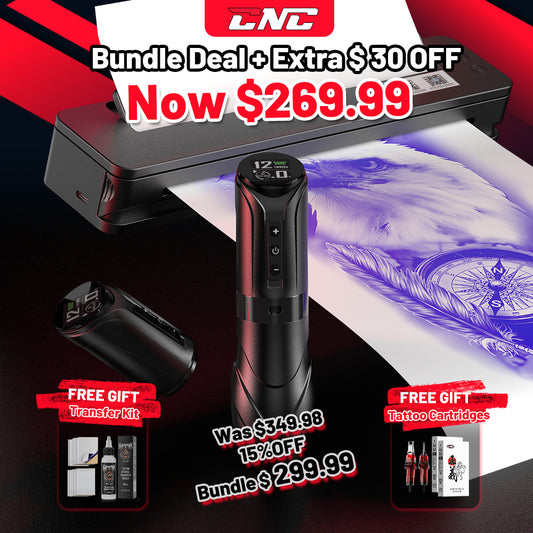

CNC Kronos vs Aurix vs E77 Pro: Which Wireless Tattoo Machine Should You Buy?
Introduction
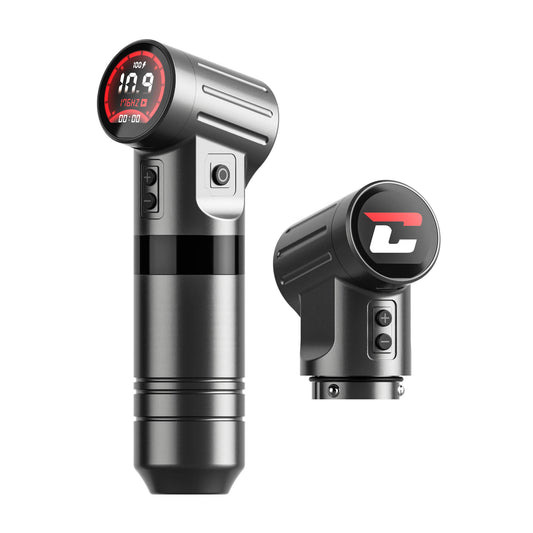
Shopping for a wireless tattoo machine usually comes down to comparing screens, battery numbers, and price tags. But three machines can look nearly identical on a spec sheet and still feel completely different in the hand. CNC's Kronos, Aurix, and E77 Pro sit in a similar price range, yet each one is built around a different idea of what a tattoo machine should do.
This guide breaks down what actually separates these three machines — how they deliver power to the needle, how they're controlled, and what kind of artist each one is built for — so you can match the machine to your own style instead of just picking the one with the most buttons.
Two Ways of Thinking About Stroke Length
Before comparing specs line by line, it helps to understand two different design philosophies these machines represent.
Adjustable Stroke: One Machine, Multiple Techniques
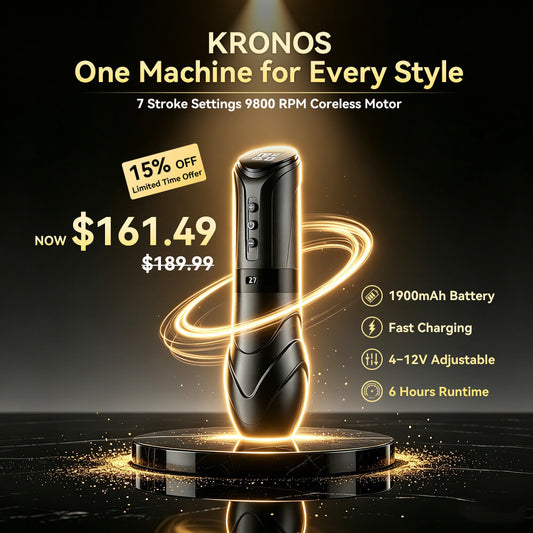
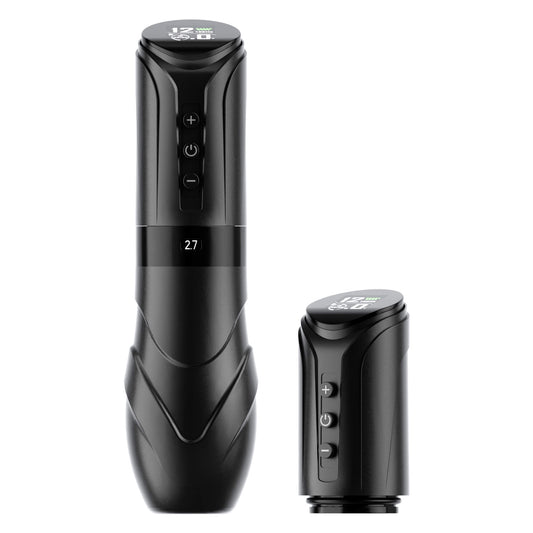
Some machines, like the Kronos, use a geared or cam-based system that lets you twist the machine body to change stroke length. This gives you a range — in the Kronos's case, seven settings between 2.7mm and 4.5mm — so a single machine can move from fine linework to heavier shading and color packing without switching pens.
The appeal is obvious: fewer machines to buy, fewer machines to carry, and one tool that adapts as your session changes.
Direct Drive: One Stroke, Done Consistently
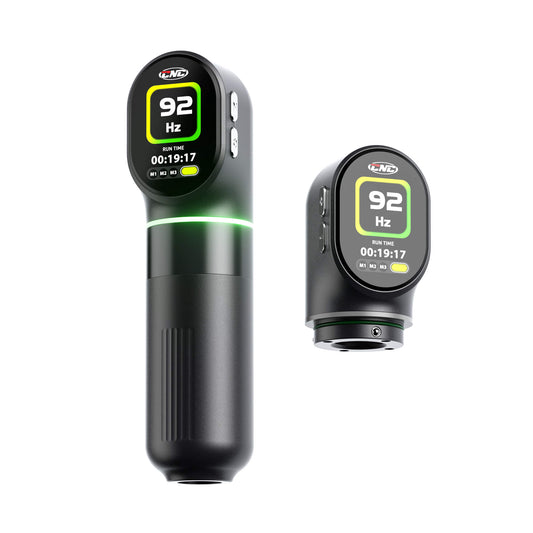
The Aurix takes a different approach. Instead of a geared mechanism, its motor shaft connects directly to a fixed eccentric wheel that drives the needle bar — no intermediate gearing at all. This direct-drive design sends more of the motor's power straight to the needle, which shows up as a firmer, more decisive stroke, especially during bold linework and solid color packing.
The tradeoff is that stroke length is fixed at 4.0mm. There's no twisting the grip to change it. Instead, the Aurix compensates with a wide 3–150Hz frequency range, letting you fine-tune needle feel through speed rather than stroke length.
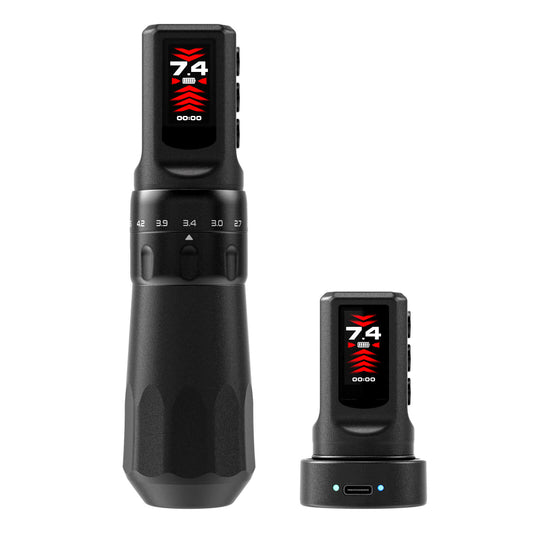
The E77 Pro also runs a fixed 4.0mm stroke, but takes a simpler, more traditional build — no drive-system marketing angle, just a dependable pen aimed at covering a broad range of techniques without extra complexity.
Neither approach is objectively “better.” It depends on whether you'd rather have one machine that flexes across techniques, or one machine that does a narrower job with maximum consistency.
CNC Kronos vs Aurix vs E77 Pro: Spec Comparison
|
Feature |
KRONOS |
AURIX |
E77 PRO |
|
Price |
$189.99 |
$269.99 |
$189.99 |
|
Drive System |
Adjustable-stroke gear system |
Direct drive, fixed stroke |
Fixed stroke |
|
Stroke Length |
7 settings, 2.7–4.5mm |
Fixed 4.0mm |
Fixed 4.0mm |
|
Motor |
Coreless motor |
Custom outer-rotor brushless motor |
Coreless motor |
|
Control Method |
4–12V adjustable voltage |
Constant 12V + 3–150Hz frequency control |
5–12V adjustable voltage, 83–199Hz |
|
Battery |
Dual 1900mAh batteries |
Dual 1520mAh batteries |
Dual 1600mAh batteries |
|
Charging Time |
3 hours |
45 minutes |
2 hours |
|
Weight |
264.5g |
220g |
224g |
Breaking Down Each Machine
CNC Kronos: Best for Versatility Across Styles
The Kronos is built for artists who don't want to be locked into one technique. With seven stroke settings ranging from 2.7mm to 4.5mm, it can move from delicate fine-line work to heavier shading and packing without switching machines. If your day involves jumping between different styles — or you simply don't want to own multiple pens — this range is the Kronos's biggest selling point.
The tradeoff is mechanical: adjustable-stroke systems rely on more moving parts than a direct-drive setup, so it's worth keeping an eye on performance consistency during long-term, high-frequency use.
CNC Aurix: Best for Power and Consistency
The Aurix is built around a different priority — delivering as much of the motor's power to the needle as possible, every single time. Its direct-drive mechanism skips the gearing that adjustable-stroke machines rely on, which translates to a firmer, more solid stroke that's particularly noticeable during bold linework and solid color packing.
Rather than adjusting stroke length, artists dial in needle feel using the Aurix's 3–150Hz frequency range on a constant 12V output — a setup that removes the guesswork of manually recalibrating voltage for every needle configuration. The machine also stores three customizable frequency presets (M1, M2, M3), so you can switch between outlining, shading, and packing settings instantly instead of resetting values each time you change techniques.
Add in 45-minute fast charging — with just 5 minutes of charge providing roughly 40 minutes of runtime — and the Aurix is built for artists running back-to-back appointments who don't want battery anxiety slowing down the day.
The obvious limitation: no stroke adjustment. If your work depends on switching between very different stroke lengths within a single session, this isn't the machine for that. For artists working primarily in bold linework, black and grey, or color packing, though, it's a non-issue.
CNC E77 Pro: Best All-Around Fixed-Stroke Machine
The E77 Pro also runs a fixed 4.0mm stroke, but earns its reputation through raw versatility within that single setting. Hands-on testing shows it holds up across fine lining, bold linework, whip shading, and solid packing — with notably low vibration and stable needle feel even at lower voltages.
What stands out is how usable the E77 Pro is across a wide voltage range. Testing found clean, consistent linework as low as 7 volts, with soft, buildable shading achievable in the 5–6V range and confident color packing around 6V. For a fixed-stroke machine, that kind of range is unusual — it behaves less like a single-purpose pen and more like a flexible, all-round tool that just happens to have one stroke setting.
At the same price point as the Kronos, the E77 Pro is a strong option for artists who want dependable, broad performance without needing to manage stroke settings at all — plug in, dial in your voltage, and go.
How to Choose Between Them
If you're still weighing your options, here's a simple way to think about it:
Choose the Kronos if your work spans multiple techniques and you want one machine that can adjust to match — fine lines one session, heavier shading the next.
Choose the Aurix if your priority is maximum power delivery and consistency, especially for bold linework and color packing, and you're running a high-volume schedule where fast charging and preset memory save real time.
Choose the E77 Pro if you want a straightforward, all-around machine at an accessible price — no stroke settings to manage, just consistent performance across a wide voltage range.
Final Thoughts
There's no single “best” machine among the Kronos, Aurix, and E77 Pro — each one is built around a different tradeoff. The Kronos prioritizes flexibility, the Aurix prioritizes power and consistency, and the E77 Pro prioritizes simplicity without sacrificing range. The right choice comes down to how you actually work: whether you value adaptability across techniques, raw power on a narrower set of styles, or a dependable machine that doesn't ask you to think about stroke settings at all.