
















Dot Work Tattoos: The Artist's Complete Guide
Imagine a tattoo with no solid lines, no filled black masses — just thousands of tiny dots, each placed with intention, collectively conjuring shadow, texture, and form. That is dot work: a technique as ancient as tattooing itself and as exacting as any fine art discipline.
For tattoo artists, dot work is not simply another style to add to the portfolio. It demands a fundamental shift in how you think about tone, density, and time. Where conventional shading uses gradient washes and smooth blending, dot work builds its entire visual world one puncture at a time. Every mark is permanent and irreducible. There is no blending away a mistake.
This guide is written for working tattoo artists who want to understand dot work at a deeper level — its technical foundations, its design logic, and how to approach the style with genuine craft. Whether you are new to the style or looking to refine your approach, the following pages offer a framework for thinking in dots.
What Is Dot Work? Reframing the Fundamentals
At its most basic, dot work (also called stippling or pointillism tattooing) is a technique that uses individual dots of ink, placed at varying densities, to create tonal gradations and visual form. There are no continuous lines. There is no gradient blending tool. The full range from bright highlight to deep shadow is built entirely through the spacing and clustering of points.
Dot work vs. line work: a structural difference
In traditional line-based tattooing, tonal weight is controlled by line width and spacing. The line itself is the fundamental unit of visual information.
In dot work, that unit is the dot. Tonal control comes from three variables: how large each dot is, how deep it sits in the skin, and how closely dots are spaced to one another. A region of tightly packed small dots reads as a mid-gray. The same dots spread further apart produce a lighter value. Larger, deeper dots increase perceived darkness.
Dot work has very low tolerance for inconsistency. An unevenly spaced cluster does not blend into the surrounding texture — it stands out as a permanent record of the moment your pressure or rhythm slipped. Consistency of pressure, angle, and rhythm is not optional; it is the technique.
Technical Foundations: The Variables That Matter
Dot work is unforgiving of sloppy technique precisely because its visual logic is transparent. In a shaded tattoo, inconsistencies can be softened in post-processing or blended with additional passes. In dot work, each point is its own permanent record. Getting the technique right from the start is not optional.
There are three primary variables that control the tonal result in dot work: dot spacing, dot diameter, and dot depth. Understanding how each one operates — and what happens when any one of them fails — is the foundation of technical competence in the style.
The three parameters: spacing, diameter, and depth
Dot spacing: Spacing is the most visible variable and the one artists develop the most intuitive control over. Tightly clustered dots read as dark values; widely spaced dots read as light. The gradient between shadow and highlight is built by gradually increasing spacing as you move from dark zones toward light. The challenge is achieving consistent spacing within a density region — irregular spacing within a mid-tone reads as noise, not texture.
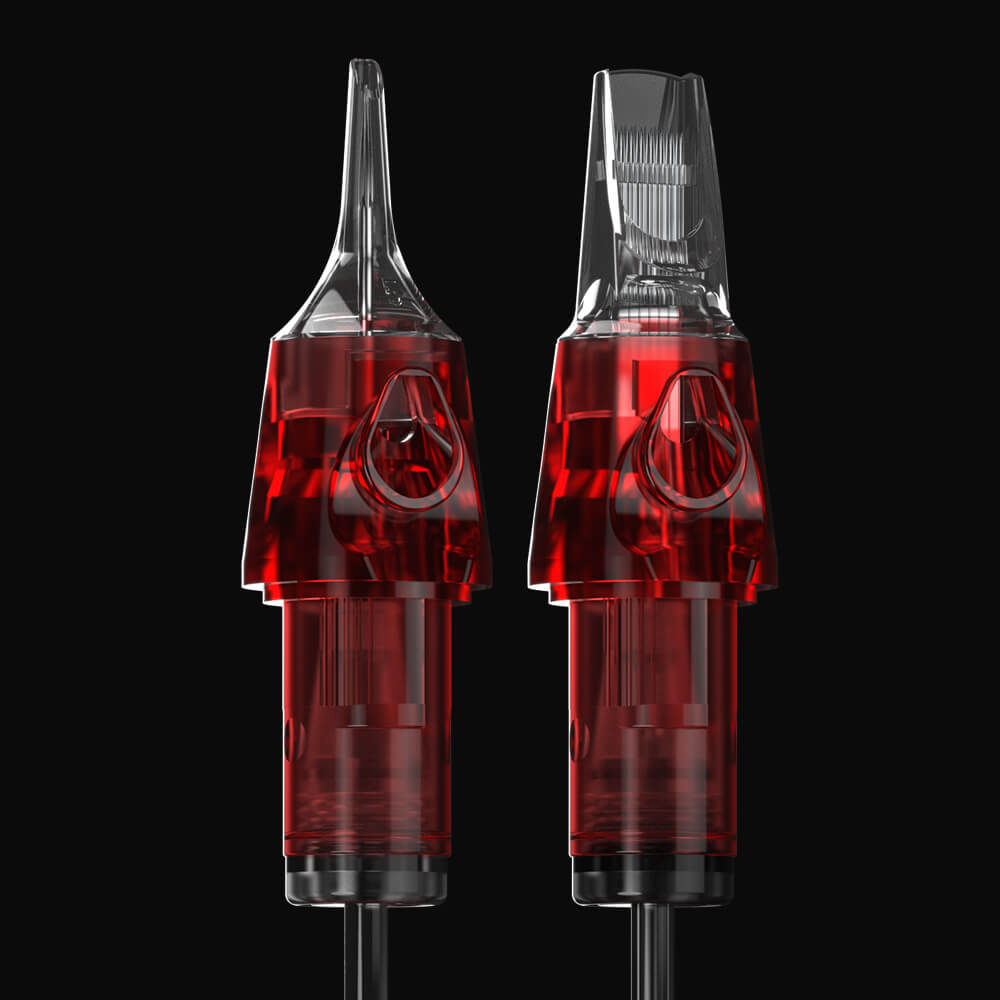
Dot diameter: Dot diameter is controlled by needle gauge and the amount of ink deposited per strike. Finer needles (single round, 3RL) produce smaller dots; larger configurations produce broader marks. In standard dot work for detailed pieces, most artists work in the 3RL to 7RL range, with single-needle work reserved for extremely fine detail or delicate gradients. Diameter affects how quickly the perceived value changes with spacing adjustments — larger dots produce a coarser halftone, which can work beautifully in bold geometric pieces but can undermine subtlety in portrait or organic work.
Dot depth: Depth is the variable most often underestimated by artists new to dot work. The target is the papillary dermis — approximately 1 to 2 mm below the skin surface. Shallow work fades rapidly as the skin renews. Deep work causes blowout: the ink spreads laterally, softening dot edges and compromising the crispness that makes dot work visually coherent. In dot work, blowout is particularly damaging because there is no surrounding fill to absorb a slightly spread dot — the migration is immediately visible against the open skin.
Needle selection for dot work
Most experienced dot work artists work with a small selection of needle configurations, chosen based on the scale and detail requirements of the piece:
- Single needle (1RL): Maximum precision. Used for extremely fine detail, thin gradient transitions, and micro-scale work. Slow, demanding, unforgiving of inconsistency.
- 3RL to 5RL: The most common range for dot work. Produces clean, medium-scale dots that remain legible after healing. Suitable for the majority of geometric and organic dot work pieces.
- 7RL to 9RL: Used for larger-scale marks in bold blackwork or to rapidly build dark density in large shadow areas. Less common for fine dot work.
- Magnum configurations: Occasionally used for soft stipple shading effects, but not typical for precise dot work. The spread of a magnum head makes individual dot control difficult.
Machine vs. hand poke: different muscle memories
Dot work can be executed with a machine (rotary or coil) or by hand poke. The technical results can be nearly identical when both are done well, but the physical technique is completely different.
Machine dot work requires deliberate control of voltage. Lower voltage reduces the machine's speed, allowing the artist to place individual dots rather than produce a continuous stroke — each mark placed with intention rather than swept across the skin.
Hand poke requires a different kind of consistency: controlled, rhythmic pressure. The artist must calibrate how hard to push for reliable depth penetration without going too deep, and maintain that calibration across hours of work. Hand poke tends to be gentler on the skin, which can reduce swelling during long sessions — an advantage for highly detailed work in sensitive areas.
Both approaches reward practice on synthetic skin before attempting on clients. The most useful exercise: create a 5×5 cm grid and fill each cell with dots at a consistent density, then create a gradient strip moving from maximum density to open skin across 10 cm. Smoothness of transition and consistency within density regions are the benchmarks.
Design Logic: Building Images from Points
Technical precision is necessary for dot work but not sufficient. The other half of the discipline is compositional intelligence — understanding how to design an image that works in this medium. Dot work has a specific visual logic, and designs that ignore it produce work that is competent but uninspired. Designs built for the medium produce work that looks like nothing else in tattooing.
Visual weight: density and negative space
The most fundamental compositional principle in dot work is the management of visual weight through density contrast. The darkest regions of a piece are built from dense, tightly spaced dots. The lightest regions are open skin — uninked, untouched. Between these extremes lies the full tonal range.
What separates strong dot work design from weak dot work design is often the handling of that lightest register: the willingness to leave significant areas of skin completely open. Beginning dot work artists tend to fill nervously — adding dots where there should be air, closing down the negative space that gives the piece its luminosity. The result is a piece that reads as a uniform mid-gray mass rather than a tonal composition with depth and contrast.
Dot work and geometric design: a natural fit
Dot work has a particular affinity with geometric design for structural reasons, not just aesthetic ones. Geometric forms — grids, polygons, concentric circles, repeating modular patterns — are built on precise spatial relationships. That precision creates a natural alignment with dot work technique: when the compositional structure demands exactness, the discipline of placing each dot deliberately becomes an asset rather than a constraint. Geometric designs also function as a self-checking system. Because the forms are mathematically defined, any inconsistency in dot spacing becomes immediately visible against the surrounding regularity. The geometry holds the dot work accountable.
Creating depth with dot gradients
One of the most powerful effects available in dot work is the illusion of three-dimensional space through tonal gradient. Because dot work builds its tonal range from open to dense, and because the eye reads dense regions as receding shadow and open regions as advancing light, a well-designed dot work piece can have extraordinary apparent depth.
The technique is essentially the same as in classical drawing: establish your light source conceptually before placing any marks, then build density in regions that would logically fall in shadow. The specific dot work challenge is the transition zone — the gradient between light and shadow. In pencil drawing, this can be blended continuously. In dot work, it must be built stepwise: reduce dot spacing as you approach shadow, increase it as you approach light, and ensure the steps are small enough that transitions read as smooth to the eye at viewing distance.
Conclusion: The Discipline of the Point
Dot work is, in the end, a practice of attention. Each dot placed correctly is a small act of craft; ten thousand of them together produce something that has no substitute in the visual vocabulary of tattooing. The technique is ancient, but its logic is timeless: build something complex from simple, irreducible units, and trust that the accumulation of careful marks will produce a result no single mark could achieve alone.
For artists who take it seriously, dot work offers more than a style — it offers a way of seeing. Learning to think in densities, to read an image as a field of potential dots rather than as lines and fills, changes how you approach all tattooing. The patience it demands becomes a professional asset. The precision it requires sharpens every other technical skill you have.
Start with a grid. Practice your densities. Study the engravers. The dots will follow.